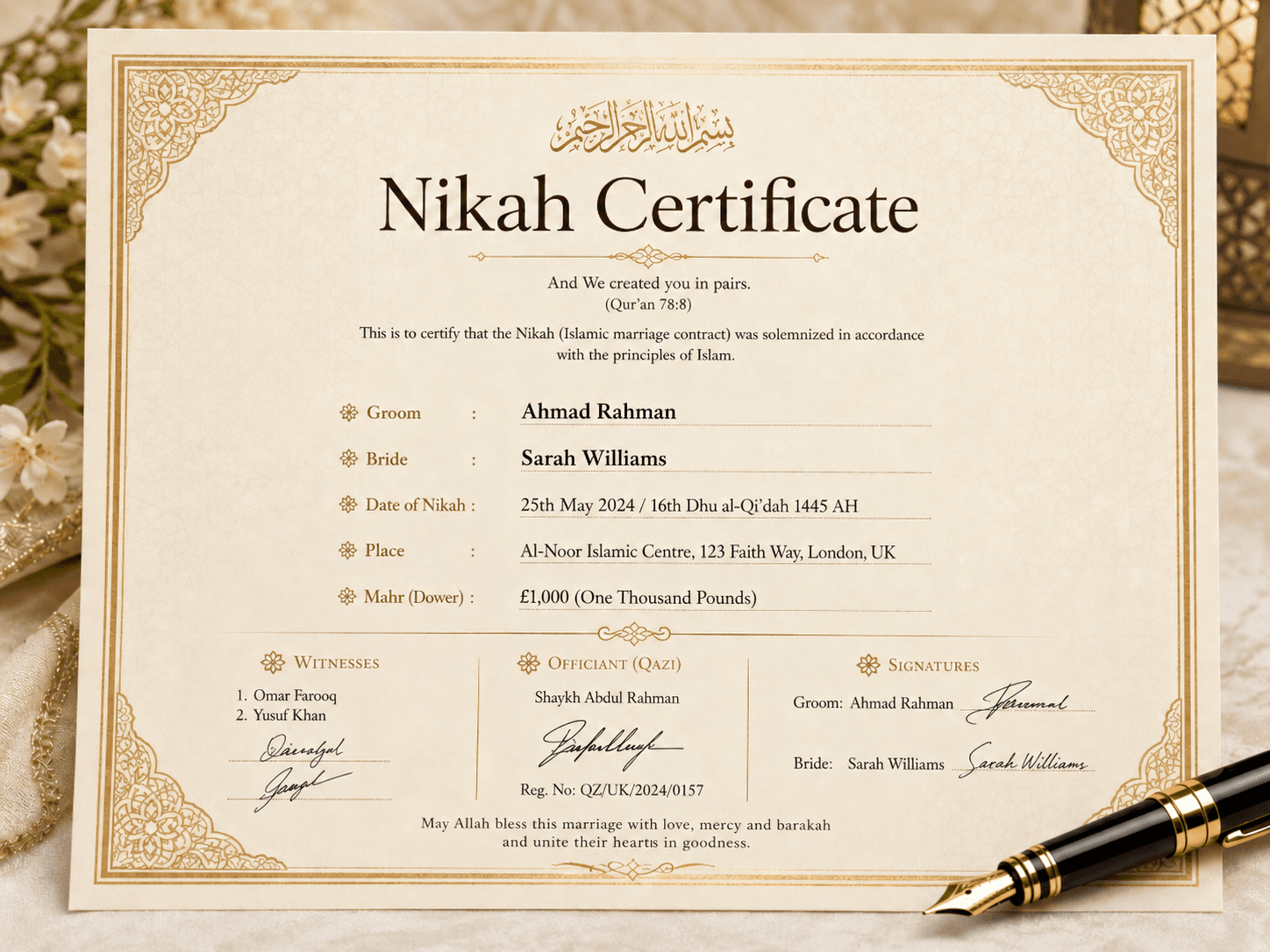
Marriage in Islam is not merely about fulfilling one’s desires, passions, or even companionship. Marriage is an act of worship. It is something that completes a person’s deen, shapes family life, affects children, influences values, and determines a person’s long-term spiritual direction.
For that reason, the question of a Muslim man marrying a Christian or Jewish woman, from the Ahl al-Kitab, the People of the Book, is a delicate matter. It must be approached with balance.
Some people make it sound absolutely impermissible. That is not correct, because Allah Most High has allowed it in the Qur’an. At the same time, it is not something that should be taken casually, without thinking about the consequences.
Allah Most High says:
“And lawful for you in marriage are chaste women from among the believers and chaste women from those who were given the Scripture before you.”
This means that, in principle, a Muslim man may marry a chaste woman from the People of the Book. However, the practical and spiritual risks need to be carefully considered.
The Basic Fiqh Ruling
In the Hanafi books, it is clearly mentioned that it is permissible for a Muslim man to marry a woman from the People of the Book.
However, many scholars also mention *karahah tanzihiyyah*, meaning that it is disliked, because of the potential negative consequences. This is also connected to the famous position of Sayyiduna Umar ibn al-Khattab, may Allah be pleased with him, who discouraged and even prohibited some Companions from such marriages due to the harm and consequences he feared.
Some scholars have gone further and mentioned *karahah tahrimiyyah*, meaning prohibitively disliked, where there is a strong likelihood that the marriage will negatively affect the man’s religion, his practice, his household, or the Islamic upbringing of the children.
And if the marriage reaches a point where it jeopardises his actual iman and belief, then it would become haram.
So the ruling is not one flat answer in every situation. It depends on intention, circumstance, and likely consequence.
When Could It Be Rewardable?
If a Muslim man marries a woman from the People of the Book with a sincere intention to show her the beauty of Islam, to influence her towards Islam, and to establish a household upon Islamic values, then there may be reward in that intention.
This was one of the wisdoms behind the allowance. Historically, Muslim men marrying women from the People of the Book could allow those women to see Islam directly and purely, rather than only hearing distorted ideas about Islam from those who had rejected the Prophet, peace be upon him.
The woman would come into a Muslim household, see Islam in practice, and potentially accept Islam. She could then also carry a true understanding of Islam to others around her.
This is one of the wisdoms scholars have mentioned behind why Muslim men were permitted to marry women from the People of the Book, while Muslim women were not permitted to marry non-Muslim men.
Are Christians and Jews Today Still Ahl al-Kitab?
Some people argue that Christians and Jews today are no longer truly from the People of the Book because their beliefs have changed, their scriptures have been altered, or because Christians believe in the Trinity and other beliefs that Islam clearly rejects.
However, this reasoning is not correct.
The Qur’an itself addressed Christians who held incorrect beliefs, including belief in the Trinity and the divinity or sonship of Isa, peace be upon him. Yet despite those corrupt beliefs, the Qur’an still referred to them as the People of the Book and still gave the ruling regarding marriage.
So, if a woman identifies as Christian or Jewish, she is treated as being from the People of the Book for this ruling.
Just as a Muslim who is not practising is still considered Muslim if he identifies as Muslim, likewise a Christian or Jew who is not practising is still treated as Christian or Jewish if they identify as such.
Therefore, the ruling of the People of the Book applies to them.
We Cannot Make Haram What Allah Has Made Halal
It is important not to declare something absolutely haram when Allah Most High has made it permissible.
A person may feel uncomfortable with such a marriage. A scholar may strongly discourage it due to real harms. In certain circumstances, it may even become prohibitively disliked or haram because of external factors.
But the original Qur’anic allowance remains.
The balanced position is this:
The base ruling is permissibility, but the practical circumstances can change the ruling from permissible, to disliked, to prohibitively disliked, and in some cases to haram.
The Real Question Is Not Only “Is It Permissible?”
Many people ask: “Is it permissible for me to marry her?”
But that is not the only question.
A Muslim man should also ask:
Will this marriage protect my iman?
Will it bring me closer to Allah or take me further away from Allah?
Will my children be raised as Muslims?
Will Islamic values be established in the home?
Will she support my religion or gradually weaken my practice?
What will happen if I die before the children grow up?
These are not small questions. They affect generations.
The Risk to Children
One of the biggest issues is the upbringing of children.
At the beginning, when a man is emotionally attached and strongly wants to marry her, he may agree to almost anything. They may agree that they will not “force” religion on the children and will let them decide when they are older.
At the time, he may not see this as a problem because his focus is on marrying her.
But a few years later, when children are born, he may realise the seriousness of Allah’s command:
> “Protect yourselves and your families from the Fire.”
He may then want to teach his children Islam, take his son to the masjid, enrol his children in maktab, teach them Qur’an, and give them an Islamic upbringing.
But now the wife may not agree.
If he insists, she may react by taking the children to church, even if she was not previously practising. Sometimes this happens simply as a reaction to him trying to push Islam more strongly.
And children, especially when young, are often more emotionally attached to the mother. This can make the situation even more difficult.
Festivals, Food, Lifestyle and Daily Values
There are also many practical matters people do not think about properly before marriage.
What happens at Christmas and Easter?
What happens if she wants wine with meals?
What happens if she eats pork or brings non-halal food into the home?
What happens if she allows the children to eat things that are haram?
What happens with music, dress, gender interaction, modesty, and Islamic boundaries?
What happens when the children visit her parents?
What happens if her family wants a baptism?
What happens with church weddings, funerals, birthdays, family events, and religious customs?
A person may think these are small issues before marriage, but after marriage, and especially after children, these matters become very real.
The Influence of Her Family
Sometimes the woman herself may seem soft, understanding, and open-minded. She may not initially object to the man’s Islamic practice.
But her family may later put pressure on her.
They may want the children involved in Christian ceremonies. They may want influence over the child’s name, food, celebrations, school life, or religious identity.
This is why it is not enough to only think about the woman herself. A man must also consider the wider family environment that his children will be exposed to.
What If the Marriage Breaks Down?
Another major issue is what happens if the marriage breaks down.
In many Western countries, if there is a separation and the children are young, they may end up primarily with the mother. In that situation, the father may have very limited control over their Islamic upbringing.
The legal system will not necessarily favour his desire for an Islamic upbringing. So he may later find himself unable to ensure that his children are raised as Muslims.
This is a serious matter.
What If He Dies Early?
A man also needs to ask himself: what happens if I pass away while the children are still young?
Will my wife raise them as Muslims?
Will she allow the Muslim community or family to support their Islamic upbringing?
There have even been cases where a Muslim man passed away and his non-Muslim wife refused to release the body to the Muslim community for an Islamic funeral. Instead, she had him cremated.
These are not theoretical issues. These are real-life consequences that people often fail to think about.
Compatibility Must Also Be Considered
Even aside from the religious issues, compatibility needs to be taken seriously.
A woman from a very different religious and cultural background may have a very different approach to food, cleanliness, etiquette, modesty, family life, marriage roles, and raising children.
How much will she adjust to him?
How much will he adjust to her?
Will the marriage itself survive those differences?
A marriage can break down because of compatibility issues even before reaching the deeper religious concerns.
The Man Must Be Strong in His Own Religion
If a Muslim man wants to go ahead with such a marriage, he must first be strong in his own religion.
He should have knowledge.
He should be firm with halal and haram.
He should have clear boundaries.
He should not have an inferiority complex about Islam.
He should not be someone who is easily influenced away from Islamic values.
If he is strong, then perhaps he can positively influence the household. But if he is weak himself, then he needs to think very carefully before entering such a marriage.
A weak Muslim man marrying into a non-Muslim environment may not raise her towards Islam. Instead, he may be pulled away from Islam.
Do Not Enter With Deception
A man should also not enter the marriage with a temporary or unserious mindset.
He should not think, “I’ll just marry her for now,” or “I’m not fully committed long-term.”
That would be deception.
Marriage is a serious covenant. He must understand what he is entering into and be honest about his intentions.
Why Not Marry a Muslim Woman?
Another important question is this: if there are Muslim women available, then why choose a woman from the People of the Book over a Muslim woman?
The Prophet, peace be upon him, encouraged a person to choose religion when selecting a spouse. Religion is not a small factor in marriage. It is the foundation of the home, the family, and the upbringing of children.
So a man must ask himself honestly:
Am I choosing her for deen and long-term benefit?
Or am I choosing her because of beauty, attraction, desire, or worldly reasons?
If it is purely desire and attraction, then this is exactly why scholars discouraged such marriages.
Final Advice
The issue is not simply whether the marriage is technically valid.
Yes, the Qur’an allows a Muslim man to marry a chaste woman from the People of the Book.
But the real question is whether this marriage will protect his deen, his future children, his home, and his akhirah.
So before proceeding, a Muslim man should ask himself:
Will this marriage make me closer to Allah?
Will she support my Islam?
Will my children be raised clearly and confidently as Muslims?
What will happen if we disagree about religion?
What will happen if the marriage breaks down?
What will happen if I die?
Am I strong enough in my own religion to lead this home Islamically?
Am I marrying for the right reason?
If the answers to these questions are not clear, then he should not rush.
This is why scholars have discouraged such marriages, not because they are denying the Qur’anic allowance, but because they understood the consequences that often follow.
Marriage is not only about the person you love today. It is about the home you will build, the children you may raise, the religion you will preserve, and the direction in which you and your family will walk towards Allah.